Language Learning Guides
The Intermediate Plateau

THE SHORT ANSWER
The intermediate plateau is a feedback problem.
Larry Selinker, who coined interlanguage in 1972, estimated about 95 percent of adult learners stop short of native-like competence, usually at intermediate level. The mechanism is fossilization: errors nobody corrects harden into habit while comprehension keeps growing. What restarts progress is producing the language at your weak points, with immediate correction, not more input or more motivation.
There was a stretch, early on, where you got noticeably better every week. New words unlocked whole conversations. Grammar that baffled you in the spring felt automatic by the fall. Then, somewhere in the middle, that feeling quietly stopped. You can read the news, follow most of a film, hold a conversation if people are patient. And yet the s ense of getting better, week over week, is gone.
This is the intermediate plateau, and almost everyone who reaches a working level of a language passes through it. Most learners read it as a verdict: this is as far as I go. The research reads it differently. It is what skill development looks like at this stage, made worse by a specific gap in how most people practice, and this piece lays out that gap and how to close it.
What the “plateau” actually is
The first useful idea here is more than fifty years old. In 1972, linguist Larry Selinker coined the term interlanguage: the system a learner actually speaks, not their first language, not yet the target language, but a rule-governed language of its own that keeps moving toward the target as you learn. The plateau is the point where, for a lot of learners, it stops moving.
Selinker called that stopping point fossilization: forms that stabilize and persist despite continued exposure and instruction. The word you always get wrong, the tense that comes out a shade off. These are not signs you are incapable. They are stabilized habits that harden in the absence of one specific thing, which we will come to.
95% of second-language learners stop short of native-like competence, Larry Selinker’s own estimate. Many read that as a ceiling, but “native-like” is a far higher bar than fluency, and stalling short of it isn’t the same as maxing out.
Why the gains feel like they vanished
At the plateau, you may still be learning at roughly the same rate as before. What changed isn’t the learning. It’s what each new piece of learning feels like.
Language follows a pattern called Zipf’s Law: a small number of words do most of the work, and the top 1,000 word families cover something like 80% of an ordinary text. As a beginner, nearly every word you learned was high-frequency, so each one opened a noticeable chunk of the language. By intermediate, you already know the words that do the heavy lifting, so what’s left is rarer and covers a thinner slice of what you read and hear. You’re adding vocabulary at the same pace; each addition just returns less visible benefit, and the feeling of a ceiling arrives well before any actual ceiling does.
~3,000
word families typical at B1
~3,500
word families typical at B2
8,000–9,000
word families to read native texts unassisted
That gap is the heart of the lexical problem: reading native-level text comfortably takes roughly 8,000 to 9,000 word families, and intermediate learners typically sit at a third of that. The authentic novel and the native-speed film sit below that threshold. Not a personal failure. Just the math of language learning at this stage.
The five things that stall at once
The most cited treatment of all this comes from Jack Richards’s 2008 work Moving Beyond the Plateau, which named what holds intermediate and advanced learners back. It is rarely one thing:
Vocabulary stuck in the high-frequency band. You lean on common words you know well, rather than the precise, less common ones a situation calls for.
Language that communicates but does not sound natural. It works, but comes out a little formal or bookish, missing the rhythm and set phrases of how people actually talk.
Fossilized errors that keep coming back. The same mistakes resurface even after correction, because correction alone, encountered once, rarely dislodges a habit.
Thin command of the harder grammar. Nuance, register, and which words naturally go together are easy to leave half-learned.
Understanding running far ahead of producing. You comprehend much more than you can say, and the gap keeps widening.
That last one is the engine behind most of the rest.
Understanding and speaking are different skills
The single most important thing to know about the plateau is that comprehension and production are not the same ability, and they are built by different activities.
In the 1980s, Stephen Krashen argued that we acquire language by understanding messages slightly above our current level, comprehensible input. He is right that input is essential, but he also made a stronger, contested claim: that input alone is sufficient to build full command of a language.
Merrill Swain tested that on French immersion students in Canada who had years of rich, comprehensible French. They understood the language well, and still could not produce it accurately, because they were rarely required to. From this she proposed the Output Hypothesis: producing language does cognitive work comprehension does not. Recognizing a word on a page is easy; summoning it mid-sentence is a different act. Input lets you glide over what you don’t know; output makes you collide with it, and that collision is where the learning is.
Knowledge also moves through stages: a rule you know explicitly but can’t apply smoothly, a rule you can apply with effort, and a rule that runs automatically. The plateau lives in that middle stretch. You know the rules; you just can’t run them in real time, under conversational pressure, and explicit knowledge doesn’t quietly convert into automatic skill. It takes practice in the thing you’re automating, which means producing, not just absorbing.
“Input built a fluent understander. Speaking is a separate skill, and it gets built by producing the language, not by consuming more of it.”
The loop most learners never close
Output is the missing half, but output alone isn’t the whole answer, and this is where the plateau finally becomes solvable rather than just explainable.
Output without correction rehearses your errors: you speak, make the same approximate choice you always make, nothing flags it, and the habit gets one more repetition. That’s how fossilization sets in, not too little practice, but practice that quietly reinforces the wrong form because nothing ever closes the loop. What closes it is feedback: explicit, in-the-moment correction, tied to the underlying rule, which outperforms leaving learners to absorb corrections implicitly, or not at all.
This is the loop. Input builds understanding, output builds production, feedback turns production into accuracy. Most intermediate learners have the first part in abundance, the second by accident, and the third almost never, then conclude they’ve hit their limit.
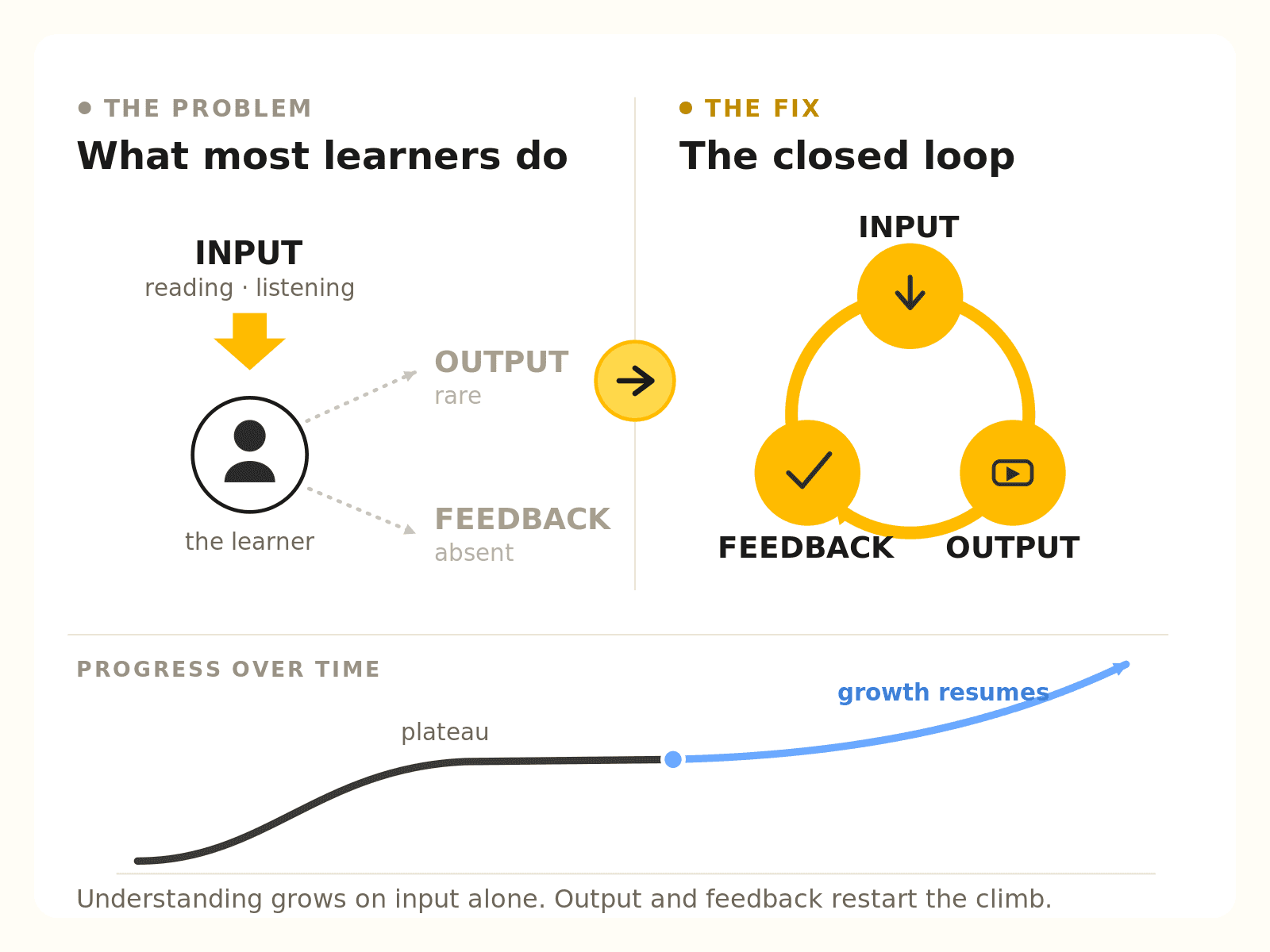
Input builds understanding. Output builds the ability to speak. Feedback corrects what you produce before it fossilizes. The plateau is what happens when the loop runs on input alone and the other two arrows never form.
Why this isn’t a lack of effort, and not your age
It is tempting to read this as a failure of will. The research suggests something more specific.
Part of what fades is real: the urgency that drove your early learning. As a beginner, the language was hard everywhere, so progress was constant. Now you know enough to get by, so practice can feel too easy to matter, or, when it’s genuinely hard, uncomfortable enough to avoid. That’s not a discipline problem; it’s a sign the practice needs to change. There’s also a quieter trap: that 95% figure, or the belief some people have a “language gene,” can curdle into treating your ability as fixed rather than something that develops, a fixed versus growth mindset, in Carol Dweck’s terms. Believing your level is set breeds anxiety; believing it develops breeds the effort that moves you.
And no, you are not too old. The belief that adults have missed the window holds for native-like accent, which depends on perception that declines with age, not for the functional command of a language that actually matters. Adults bring real advantages: explicit grammar learning, decades of practice at structured work, motivation a child doesn’t have. Time on task, quality of practice, and feedback predict success, not the year on your birth certificate.
What the research says to actually do
The findings converge on a practice model built around closing the loop, not consuming more content.
Keep input, but stop asking it to do output’s job. Reading and listening still expand vocabulary and tune your ear. Just stop measuring progress by how much you understand.
Make input easier to absorb with narrow reading. Staying with one author or topic recycles the same vocabulary in context, so the lexical ceiling stops being a wall.
Produce on purpose. Generate language deliberately, in speech and writing, rather than waiting for conversations to happen to you.
Close the loop with feedback. Output only counts as practice if it’s corrected, immediately and specifically, attached to the rule. This is the arrow most learners are missing.
Aim at your real weak points. What builds skill is not volume but deliberate practice: targeted effort on what you can’t yet do, with feedback attached.
Further reading
Jack Richards, Moving Beyond the Plateau
Foundational treatment
The clearest map of why intermediate learners stall, and the five challenges that stall them.
Full text (PDF)
Merrill Swain, the Output Hypothesis
Foundational theory
Why producing language is its own skill, drawn from Canadian immersion research.
Dioma: How Adults Actually Acquire a Language
Related guide
The input-output-feedback loop in full.
Read
How Dioma fits
Most language tools double down on the part of the loop that is least limiting at this stage: more input, delivered more pleasantly. Dioma is built around the part actually holding you in place. You produce language through structured speaking and writing, get corrective feedback the moment you slip, with the rule and not just the right answer, and the system tracks which patterns you keep missing so each session targets your real weak points. Pick the one error you know you keep making, produce ten sentences that force it, and get each one corrected before you move on.
The real shift
The plateau feels like a wall because the thing that used to tell you that you were improving, the steady arrival of high-frequency words and basic structures, has done its job and gone quiet. Years of input made you a strong understander. Speaking is a different skill, built by producing the language and correcting what you produce. The plateau is not the edge of your ability. It is the point where the easy half of the work runs out and the half that actually builds a speaker begins.
Stuck at the same level for months?
The plateau is a feedback problem, and feedback problems are fixable.
See the method →
Frequently asked questions
What is the intermediate plateau in language learning?
The stage, around the B1 to B2 transition, where early progress slows and you feel stuck even though you can already use the language, because the words and structures that drove early gains are mostly learned.
Why does my language progress feel like it stopped at intermediate?
Largely Zipf's Law: common words cover most of any text, so once you know them, the rarer words you add each cover a thinner slice, and each addition buys less obvious progress.
Is the intermediate plateau permanent, or can you move past it?
No. It's a stage of skill development, not a fixed limit. Learners move past it by shifting from input alone to deliberate production with corrective feedback aimed at their specific weak points.
Am I too old to get past the plateau and become fluent?
For functional fluency, no. Native-like accent is harder after puberty, but functional command of a language is achievable for adults. Time on task, practice quality, and feedback predict success far more than age does.
Will more comprehensible input get me off the plateau?
Usually not. Input builds understanding, which generally isn't the part that stalled. Getting off the plateau takes producing language and correcting what you produce.
Related Articles


