Resource Comparisons
Comparison
AI & Language Tools

THE SHORT ANSWER
After Duolingo, the bottleneck is producing the language, not exposure.
As of April 2026, nine Duolingo courses teach through B2, and Duolingo’s own research finds comprehension outpaces speaking from the start. Dioma delivers open-ended speaking and writing, with real-time corrections. Currently offered in Spanish, French, and Hebrew from A2 to C1. Duolingo builds the habit; Dioma builds accurate output.
You put real time into Duolingo and it worked. You built a daily habit, learned a lot of vocabulary, and got comfortable reading and following the language. Then, somewhere around the intermediate level, your progress slowed. You still open the app, but your speaking and writing are not catching up to your understanding, and you are starting to wonder whether the streak is doing much for you anymore.
You might need something different, but “different” here does not mean “better.” Duolingo and Dioma are built for different stages of the same journey, and the honest answer to “which should I use” depends on where you are.
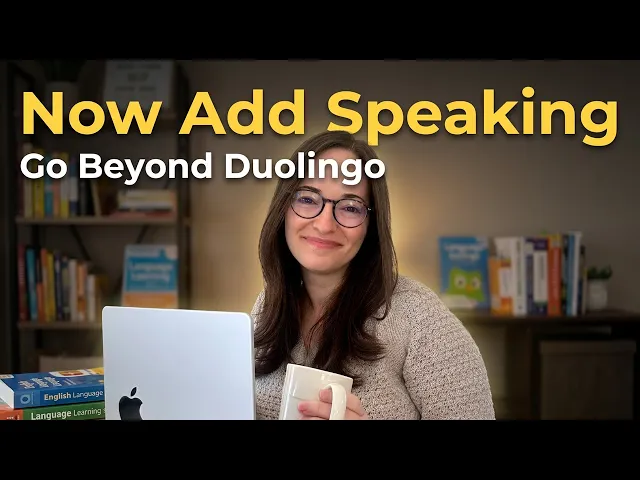
For Arielle’s comparison of Dioma and Duolingo for intermediate learners, see this Youtube video:
What Duolingo is built to do
Duolingo is the most widely used language app in the world, and it earned that. It offers more than forty languages, a free core product that anyone with an internet connection can use, and a daily-practice loop that is genuinely good at one hard thing: getting you to come back tomorrow. Its reward-driven design (experience points, streaks, leagues, and in-app gems) keeps millions of people practicing on days they otherwise would not. For building a habit and a foundation from zero, that is a real strength, and it is not one to dismiss.
The content has been getting deeper, too. As of April 2026, Duolingo announced that nine of its courses, including Spanish and French, now teach through B2 on the CEFR scale, where previously most learners could only complete content up to A2. That expansion added advanced Stories and DuoRadio episodes, which help build reading and listening at the upper-intermediate level. Duolingo’s stated reason for stopping at B2 is candid: it calls B2 “the level of proficiency that allows you to get a job in that language.”
The shape of the product shows up at the higher levels. Duolingo teaches grammar mostly implicitly, through pattern repetition rather than explicit rule explanation, with an “Explain My Answer” feature that gives a short explanation after the fact. Its exercises lean toward receptive skills, reading and listening, more than toward production. Duolingo’s own 2021 research found that learners came away with stronger comprehension than speaking even at the beginner stage, an effect that tends to compound as the grammar gets harder. Its B2 content ceiling also means that for the nine top courses, there is no further structured path once you finish B2, and no C1 or C2 content on the platform at all. For a learner whose goal is producing the language freely at an intermediate-to-advanced level, that is where the habit tool starts to run short of room.
What Dioma is built to do
Dioma starts where that foundation ends. It is built for intermediate and advanced learners (roughly A2 to C1) who already understand a lot and need to produce it. Instead of pattern-matching exercises, you do open-ended speaking and writing, and the system gives you corrective feedback with the rule attached, not just the right answer. It places you against a CEFR-aligned curriculum in the first hour and aims each short session at the patterns you personally keep missing. Across Spanish, French, and Hebrew, the curriculum runs to hundreds of structured grammar and fluency topics sequenced by sub-level, from the present subjunctive up through complex conditional sentences and discourse.
That focus comes with deliberate trade-offs. Dioma is not for beginners and does not pretend to be. It’s a new platform and currently offers three languages where Duolingo offers more than forty. It isn’t in the App Store or Google Play: it runs in the browser and installs to your phone’s home screen instead. It has no free option and no gamification mechanics. Dioma did recently add more robust tracking of your progress, but if a streak and XP is what keeps you practicing, you will not find one on Dioma. Dioma motivates instead by showing you measurable progress against your level and goals. If you are starting a language from scratch, or you mainly want broad daily exposure across many languages, Dioma is the wrong tool, and Duolingo (or a similar foundation app) is potentially the right one.
Feature
Dioma
Duolingo
Best for
Breaking the intermediate plateau
Building a habit and a foundation
Target levels
A2 to C1 (intermediate / advanced)
A1 upward; nine top courses reach B2
Core method
Open-ended output with feedback
Lessons built on pattern repetition
Speaking practice
✓ Open-ended speaking
Speaking prompts; live AI conversation on Max
Feedback on your own output
✓ Immediate, rule-based corrections
Implicit; post-answer explanations
Targets your specific errors
✓ Tracks and retargets your patterns
Spaced practice of course items
Languages offered
Spanish, French and Hebrew
40+
Reward-driven mechanics
None; progress-driven motivation
Points, streaks, leagues, gems
Free option
✗ 21-day trial, then premium
✓ Free core product (ad-supported)
Price (as of July 2026)
Starting at $13/mo
Free; Super ~$7/mo, Max ~$14/mo
How to tell which one fits you
The deciding question is not which product is better. It is what your current bottleneck is.
Choose Duolingo (or stay with it) if: you are building a foundation, you want broad daily exposure across many languages, or a streak and a leaderboard are what keep you practicing. For habit, vocabulary, and comprehension up to the upper-intermediate level in its top courses, it does this well, and the core product is free.
Choose Dioma if: you are past the basics, you understand far more than you can say, and your bottleneck is producing the language accurately under real conditions. If your comprehension keeps growing while your speaking and writing stay stuck, the missing ingredient is output with feedback, which is the specific thing Dioma is built to provide. It also matters if you are working past B2 toward an advanced level, where Duolingo’s structured path currently ends.
Use both, in sequence, if you are like a lot of serious learners: Duolingo to build the habit and the foundation, then Dioma to turn that foundation into the ability to speak and write under pressure. They are less competitors than consecutive stages.
“The question isn’t which app is better. It’s whether your bottleneck right now is exposure and habit, or producing the language accurately with correction. Those need different tools. Geoff Bloom, founder of Dioma”
The verdict
Duolingo is an excellent habit-builder and foundation tool, with a free core product, real breadth, and content that now reaches B2 in its top courses. Dioma is built for the next stage: intermediate and advanced learners who understand the language and need to produce it, through open-ended output and corrective feedback that explains the rule. If you are building a foundation or learning casually, a habit app is the right home. If you have hit the intermediate plateau and your speaking is not catching up, that is exactly the problem Dioma is designed to solve.
Where Dioma fits in a serious learner’s toolbox
No single tool makes you fluent, and Dioma does not claim to. Real progress at the intermediate level comes from a variety of inputs: exposure from native content and conversation, a foundation from structured practice, and deliberate output with feedback to build production. Think of it the way a strong athlete still practices with a coach. A skilled player does not get better by playing more pickup games; they improve by working on specific weaknesses with someone who can see what they cannot and correct it in the moment. Duolingo is excellent at getting you onto the court every day. Dioma owns the coaching part: the targeted, corrected output that turns understanding into the ability to actually speak.
Built for learners who’ve outgrown the basics
Structured curriculum, smart feedback, real progress. Try it free for 21 days.
Learn More →
Frequently asked questions
Is Dioma better than Duolingo?
Neither is better in the abstract. They are built for different stages. Duolingo builds a habit and a foundation; Dioma develops production at the intermediate and advanced level. The right one depends on where you are.
Is Duolingo good for intermediate and advanced learners?
It is more capable than it used to be. As of April 2026, nine of Duolingo's courses, including Spanish and French, teach through B2, with advanced Stories and listening content. Its limits for this group are that grammar is taught mostly through repetition rather than explicit rules, production practice is lighter than comprehension, and there is no structured content beyond B2 (no C1 or C2).
Do Dioma and Duolingo offer Hebrew?
Both offer Hebrew, but at different depths. Dioma's Hebrew is its broadest course, running from A2 through B2(upper-intermediate/advanced). Duolingo's Hebrew is not among the nine courses it expanded to B2 in April 2026, so its advanced coverage is more limited. Confirm Duolingo's current Hebrew level on its site if that is your language.
Can I use both Dioma and Duolingo?
Yes, and many serious learners do, in sequence. Build the habit and the foundation with Duolingo, then use Dioma to turn understanding into the ability to speak and write with feedback.
Does Duolingo Max replace conversation practice with feedback?
Max adds AI features, including live spoken Video Call and scripted Roleplay scenarios, which are useful exposure. They are scenario-based AI conversations rather than open-ended output with expert corrective feedback on grammar and register, which is the specific gap Dioma is built to fill.
Is there a free version of Dioma?
No. Dioma offers a 21-day free trial with no credit card, then it is a paid subscription. That is by design, to keep it ad-free and focused on committed intermediate and advanced learners rather than casual use.
Which is better for passing the DELE, DELF, or TEF?
Exams test production under pressure, which favors output practice with feedback. A foundation or habit app helps you build comprehension and vocabulary; for the speaking and writing sections specifically, structured output with corrections is closer to what the exam asks of you.
Related Articles


