Learning Science
Speaking & Output
Listening

THE SHORT ANSWER
Input is necessary; the myth is that it’s sufficient.
Krashen’s Input Hypothesis from the 1980s holds up: understandable input drives acquisition. Swain’s studies of Canadian French immersion students showed its limit: after thousands of hours of input, their grammar stayed inaccurate until they had to produce. At intermediate levels, producing the language with corrective feedback is what converts understanding into speech; Paul Nation suggests roughly equal time on each.
You did what the advice said. Podcasts on the commute, a series most evenings, a graded reader on the nightstand. And your comprehension has genuinely improved: you follow conversations that would have lost you a year ago. Then someone asks you a question, and the answer comes out slow, approximate, and two tenses simpler than the sentence you just understood. The more you consume, the wider that gap seems to get.
The advice you followed traces back to a real finding. In the 1980s, the linguist Stephen Krashen proposed the Input Hypothesis: we acquire language by understanding messages slightly above our current level. Somewhere between the research and the internet, that insight got flattened into a mantra: consume enough content at the right level and fluency will follow. Comprehensible input is not the myth here; it is one of the best-supported ideas in acquisition research. The myth is sufficiency, the belief that input alone will turn you into a speaker. At the intermediate level, it will not, and the research explains why.
What comprehensible input gets right
Krashen’s core observation holds up. When you read or listen at a level where you understand most of the words, your brain does real acquisition work: it picks up vocabulary in context, internalizes grammar patterns, and develops an intuitive feel for how the language behaves. This is how you come to sense that French depuis marks duration running from a past starting point, that Spanish wants the subjunctive after expressions of doubt, that Hebrew builds families of words from three-letter roots. Nobody memorizes their way to those intuitions. They are absorbed through exposure, which is exactly what the Input Hypothesis predicts.
Input also explains the silent period, the well-observed phase where learners focus on comprehension before they attempt much speech. Especially for beginners, that phase lets the brain build foundational structures without the cognitive load of producing at the same time.
So keep the input. Everything that follows is about what input cannot do, not an argument against what it does.
Where input alone stops working
The strongest test of the input-only idea came from an environment far richer than any app or podcast queue. In the 1990s, Merrill Swain studied students in Canadian French immersion programs, learners who had spent years of schooling inside comprehensible French. They understood the language well. They still made persistent grammatical errors and struggled to express themselves precisely, because they were rarely required to produce careful language and get corrected on it.
From this, Swain proposed the Output Hypothesis: producing language does cognitive work that comprehension does not, and no volume of understanding substitutes for it.
KEY FINDING
Swain's immersion students had received thousands of hours of comprehensible input, about as good an input environment as has ever been studied, and still could not produce accurate, precise French on demand.
Understanding had been trained. Production had not.
Four things output does that input cannot
Swain’s work, and the research that followed it, points to four specific jobs that only production performs.
It forces you to notice your gaps. Input lets you glide over what you don’t know: you can follow an entire film while glossing past every structure you couldn’t build yourself. Output removes that option. The sentence stops exactly where your knowledge stops, and now you know where that is.
It tests your hypotheses. Every sentence you produce is a small experiment about how the grammar works. Speaking and writing generate the raw material that feedback can then confirm or correct.
It builds procedural fluency. Knowing a rule and retrieving it under time pressure are different skills. You may recognize néanmoins as “nevertheless” every time you read it; summoning it while drafting an email is a separate ability, and only production trains it.
It demands precision. Comprehension tolerates ambiguity: you can get the gist of a sentence while being wrong about half its mechanics. Production exposes imprecision and makes it correctable. The Spanish subjunctive after es importante que stays theoretical until you have to build the sentence yourself and learn whether you got it right.
Input builds a model of the language in your head. Output is what tests, corrects, and automates that model.
The comprehension-production gap
Put those four jobs together and the experience so many intermediate and advanced learners describe stops being mysterious. By the middle levels you carry a substantial passive vocabulary. You can follow a conversation between native speakers, watch with target-language subtitles, read an article with the occasional dictionary check. And speaking still feels slow and effortful, while your writing reads like a patchwork of half-remembered phrases. You understand far more than you can produce, and the gap widens because your hours keep flowing to the side that is already strong.
This is not a personal deficiency; it is the predictable result of training one skill and expecting a different one to improve. Reading makes you better at reading. Listening makes you better at listening. Neither makes you much better at speaking, because relying on input to build speech is like lifting weights and expecting to run faster: the skills are related, but they are not interchangeable.
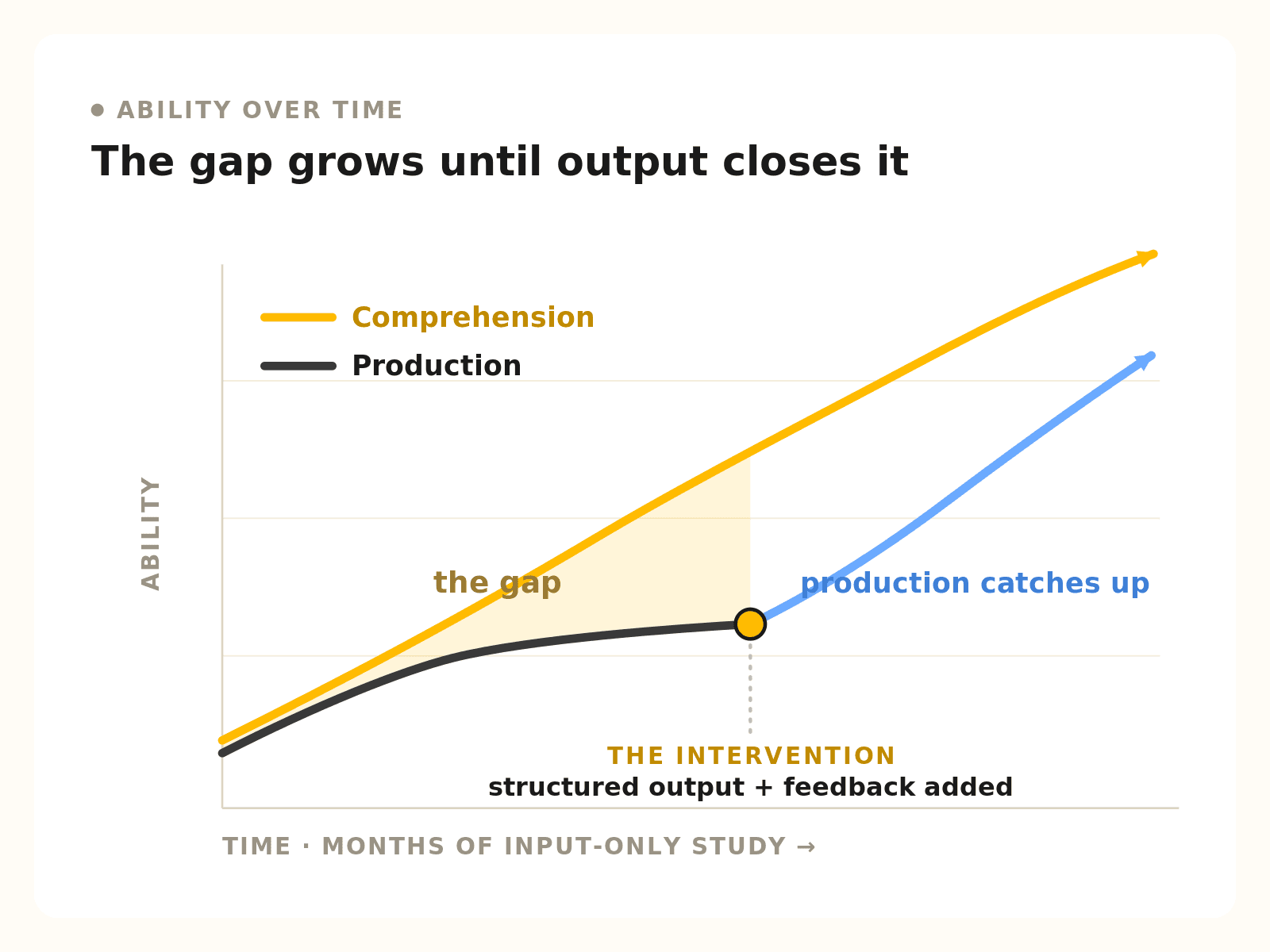
Input keeps comprehension climbing while production flattens, so the gap between what you understand and what you can say grows with every input-only month. The gap does not close on its own. It closes when structured output with feedback enters the routine.
The gap between understanding and speaking is not evidence that you are bad at languages. It is evidence that you have been training one of the two skills.
Why input-only feels so productive
If input alone stalls at this level, why do so many capable learners keep choosing it? For an honest reason: it feels productive without ever being uncomfortable. An evening of television in your target language is genuinely pleasant, and you can point to the hours afterward. A single written paragraph where you stall three times per sentence is frustrating, and you have little to show for it but crossings-out. So the hours flow toward input, and the routine feels like progress while the speaking gap quietly grows.
But at the intermediate level, acquisition largely consists of confronting what you don’t yet control. The stall, the reach, the failed retrieval: that friction is not a sign you are practicing badly, but a sign you are finally practicing the part that was missing.
“The discomfort is the point. The moment you reach for a word and come up empty is the moment the learning happens.”
Feedback is the word doing the work
None of this means output alone is the answer, and this is the step even output-friendly advice tends to skip. Output without correction reinforces errors. Say je suis allé à le cinéma for six months with nothing flagging it, and each repetition makes the habit harder to dislodge. Uncorrected practice is how mistakes fossilize.
CORRECTION
Je suis allé à le cinéma.
Je suis allé au cinéma.
Why: French contracts à + le into au. A small, mechanical rule, and exactly the kind of error that survives years of input, because nothing in a podcast ever requires you to make the choice yourself.
The research backs the intuition: learners who received corrective feedback on their output showed significantly greater grammatical accuracy than those who relied on input alone (Lyster and Saito’s 2007 meta-analysis). Timing matters as well. Correction that arrives at the moment of the error, with the underlying rule attached, does far more than a note that arrives a day later, when the sentence and the choice behind it have faded.
Output makes your errors visible. Feedback is what converts them into learning instead of habit.
What effective output practice looks like
Not all production is equal. The versions that move intermediate and advanced learners share a shape.
Writing that mirrors real communication. Not “describe your weekend,” but tasks that make you argue, explain, narrate, and persuade. Those jobs force subordinate clauses, connectors, and complex verb forms, the structures that input let you gloss over.
Speaking with immediate correction. A tutor, a trained conversation partner, or a structured tool. The immediacy is most of the value: the correction lands while your original choice is still in working memory.
Targeted work on your persistent errors. Everyone has a short list: por vs. para, French pronoun order, a tense that comes out a shade off. Isolating one pattern and drilling it with feedback moves it faster than another month of general listening.
And none of this replaces input. The most effective learners at this level keep both, with Paul Nation’s suggestion of roughly equal time on input and output as a reasonable starting point. What changes is the expectation: input for vocabulary, structures in context, and your ear; output with feedback for the ability to actually speak and write.
Where Dioma fits
If input is already in your routine, you have half of what the research asks for, and the pleasant half at that. Dioma is built to supply the other half for Spanish, French, and Hebrew learners. Every lesson requires you to produce, in writing and speech, against tasks that force real structures; the correction arrives the moment you slip, with the rule and not just the right answer; and the system tracks which patterns you personally keep missing, so your practice targets them instead of the language at large. It works as one tool among several, alongside the native content you already enjoy and conversation with real people. A concrete way to start: take the error you know you keep making and spend one session producing sentences that force it, with each one corrected before you move on.
Keep the input. Add what’s missing.
Comprehensible input carried you a long way. It built your vocabulary, your ear, and the quiet intuitions you now have about how the language works, and it will keep doing that for as long as you keep reading and listening. The myth was only ever the claim that it could carry you the whole way. Understanding and speaking are different skills, built by different activities, and the second one is built by producing the language and correcting what you produce. If your speaking has lagged behind your comprehension for a while now, you are not missing more input. You are missing the other half of the work.
Built for learners who’ve outgrown the basics
Structured curriculum, smart feedback, real progress. Try it free for 21 days.
Learn More →
Frequently asked questions
What is comprehensible input in language learning?
Language you can mostly understand: reading or listening pitched slightly above your current level. Stephen Krashen argued that understanding such messages is the engine of acquisition, and the idea is well supported for building comprehension, vocabulary, and grammatical intuition.
Is comprehensible input wrong for intermediate language learners?
No. Input remains necessary at every level. The error is expecting input alone to produce speaking ability. It builds understanding; speaking and writing are built by producing the language and getting corrective feedback on it.
Can you become fluent just by watching TV and podcasts in your target language?
You can become a strong understander that way, which is genuinely valuable. Fluent speaking and writing come from production with correction, and learners who rely on media alone typically develop a wide gap between what they understand and what they can say.
Why can I understand my target language but not speak it?
Because comprehension and production are different skills trained by different activities. An input-heavy routine trains the first and leaves the second behind, so the gap is a reflection of how you practiced, and it narrows once structured output with feedback enters the routine.
How should intermediate learners balance input and output practice?
Roughly equal time on each is a reasonable target at intermediate levels. Keep input for vocabulary and listening comprehension, and spend your highest-focus hours on speaking and writing with immediate, specific feedback.
Further reading
Stephen Krashen, the Input Hypothesis
Foundational theory
The original case for comprehensible input, and the baseline every later model responds to.
Overview
Merrill Swain, the Output Hypothesis
Foundational theory
Why producing language is its own skill, drawn from Canadian immersion research.
Dioma: The Intermediate Plateau, Why You Stopped Improving
Related guide
The wider picture this article sits inside: why gains slow at the middle levels and what restarts them.
Read
Dioma: How Adults Actually Acquire a Language
Related guide
The full input-output-feedback loop, and what it means for a weekly routine.
Read
Related Articles


